


Page 6 - Moravian Messenger Nov 2020
P. 6
Remember the forgotten
continued
The Treaty was ratified in London on the 20th October 1919 - an oddment too trifling to be considered at the Peace Conference. Britain had apparently gone to war in 1914 to defend the rights of small nations!
Think of the new nations that emerged from the war with the right of people to their national identity and independence: Poland, Finland, Czechoslovakia etc. The spoils of colonial rule were spread among the victors without regard to the native populations. Straight lines on maps are a sure sign of political expediency ignoring complex tribal, cultural and social societies especially those without a European identity.
With the carnage on the Western Front draining the manpower resources of the UK it was decided to utilise the 'coloured' populations of the colonies as non-combatants freeing up men for service in the front lines. A South African Labour Corps was raised early in 1917 but the officers and NCO's were white as none of the black men were allowed to take such a position. In addition, they were not allowed to carry arms and to mix with the white communities or other units. This was to change to some degree in Second World War.
In the silent cities of the dead that run across Northern France are listed many South Africans, with white and coloured troops laid to rest together. In death the Imperial War Graves Commission did their best to honour all.
One of the great tragedies of 1917 was
the sinking of the SS Mendi carrying of
over 700 men, many of whom came
from South Africa. Nearing the Isle of
Wight in thick fog the Mendi was
rammed by the SS Darro travelling at
high speed and failing to emit the
required fog signals. As the ship was
holed, many men died below decks, but
others gathered on deck as she began
to list and sink. Panic ensued. An
interpreter Isaac Williams Wauchope
raised his arms and shouted 'Be quiet
and calm, my countrymen, what is
happening now is what you came to
do - you are going to die but that is what you came to do. Brothers, we are drilling the death drill, let us die like brothers, I am Xhosa, say to you are my brothers - Swasis, Pondes, Basotho - We are the sons of Africa. Raise your war cries for though they made us leave our assegais in the Krall, our voices are left with our bodies'.
Isaac Wauchope had been a pastor in the congregational Native Church of Fort Beaufort a segregated church by the law of the Union at that time. Most of the men and crew died. It makes almost unbearable reading. Thankfully, the men were remembered both in the UK and South Africa with 13 buried in West Sussex where their bodies were recovered from the sea. A memorial was raised to them as was a special memorial in Soweto. The ship's bell was returned to South Africa in 2018 after it had been looted from the ship, a war grave. It was
returned from an unknown source to the BBC.
When General Allenby took Jerusalem in 1917 after defeating the Turkish forces in his Middle East campaign, men from the British West Indies Regiment were among his forces. Raised in 1915 it could trace its earlier history back to 1795. Initial recruitment was originally from freed slaves from North America and slaves actually purchased in the West Indies. They had fought in the East African campaign and in Jordan and Palestine as well as part of a multi-colonial army of Nigerians and Ghanians conquering the German colonies of Togoland and Cameroon. However, when British troops were awarded a pay rise in 1918 the men of the regiment at the time were denied it as they were classified as 'natives'. The men of the BWIR had been awarded 81 medals for bravery and 49 men were mentioned in despatches during the war.
The Imperial War Museum holds in its collections a cigarette case presented to each man to mark Christmas 1917. It is surprising what a prominent role tobacco played for both the military and civilians at the time. I wonder if families in the
Caribbean still have any of these tokens handed down through the generations.
At St Etienne Au-Mont Communal cemetery, 3 miles south of Boulogne are 163 Chinese burials from No 2 Native Labour General Hospital from the First World War. The entrance is a typical Chinese gateway which is quite a change from the standard neo- classical styles. The presence of Chinese graves is also marked across the other military cemeteries of Northern France. Their resting in France was a result of the acute manpower shortage as the war ground on. But their presence was due to a basic financial transaction. The Allies made an agreement with the Chinese government for 100,000 'Collies' to work on the Western Front. Most recruits came from the poor of the Shandoug province and initially were attracted by the promised cash bounty, a regular wage and an
allowance to their families. Most of this was lost in the inefficient administration.
As both the US and Canadian had in place an anti-Asian immigration policy the labourers were secretly landed at Victoria, British Columbia before being taken in sealed trains across Canada to Halifax and then to France. Trade unions refused them landing in the UK as they feared the government were intent in using the Chinese as cheap labour in the munition factories.
Conditions for these recruits were poor and dangerous as they had frequently worked up near the front with casualties from the artillery barrages. In 1919, 80,000 still remained in France and they were used in mine and ordinance clearance, recovering the bodies of the dead and filling in the trench systems. Many
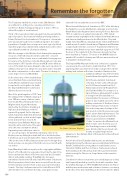
The Chattri, Patcham, Brighton
138


