


Page 7 - Moravian Messenger Nov 2020
P. 7
were ill from the poor food, housing conditions and the weather. This led to mutinies against the British authorities. Local shops were looted for food and clothing. Finally, the Corps were returned to China by the route they had travelled previously but not by name on the passenger lists, just given a reference number. The government granted them the 1914-18 war medal but this was cast in bronze while the medals for British troops were cast in silver. Tales of their experiences soon made the press across China fuelling anti-European feeling in China, a legacy that we are still living with today. In 2002, at least there was a remembrance ceremony at Noyelles-sur-Mer when the last survivor of this forgotten army, Zhu-Guisheng died aged 106. The transit camp in Metchosin, British Columbia has a burial ground and the initially un-marked Chinese graves were only finally documented in 2019.
At the Peace Conference at the end of the war the Chinese Delegation were ignored and the concessions forced earlier from the Chinese were not addressed. The trading posts established on the Chinese mainland still continued to be occupied by the Allies with two being re-allocated. One from Austro-Hungarian control was awarded to Italy while the German base at Kiatschou Bay was actually awarded to Japan. Little wonder that the Chinese delegation returned home and the peace treaty of 1919 was never ratified.
At the present time a carved marble memorial column to these Chinese soldiers lies in China still awaiting shipment to London because of disputes about its final location in London despite support from the Mayor. Memory and political considerations are now intertwined.
The Royal Pavilion in Brighton was used as a segregated hospital in the First World War for soldiers from India. The bodies of some of those who fought in the war who died there were taken to a spot high on the South Downs cremated with their ashes scattered in the channel. A memorial Chattri was built on the spot with marble from Sicily and unveiled in 1921. It rapidly fell into decline as the caretaker was not replaced on his death in early 1930. The area was taken over by the military in Second World War as the monument was casually used for target practice by troops. I wonder if it would have been allowed if it had been a British Regimental monument. 1951 saw the monument repaired by the War Office and the local British Legion made an annual pilgrimage. With the decline on membership of the Legion the local Indian community have now undertaken this role. The
Chattri bears an inscription: 'to the memory of all Indian soldiers who gave their lives for the King-Emperor in the Great War, this monument erected on the site of the funeral pyre where the Hindus and Sikhs who died in the hospital in Brighton passed through the fire, is in grateful admiration and brotherly love'.
Br Henry Wilson
Ballinderry
A Century since the ordination of the first Tibetan ministers in West Himalaya
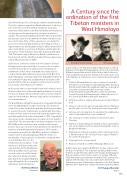
Br Joseph Thsertan Gergan
Br Dewazung Dana
In the summer of 1920, Bishop Arthur Ward made an official Visitation of the West Himalaya Mission. From 1st to 22nd July, Br Ward reviewed the work of all the field in daily Conference sessions with the missionaries. Details of the work can be seen in the Minutes of Conference. Some of the main points settled were:
1. That the Moravian Mission cannot continue to work this field unless it is done with an native Ministry. After discussing this important matter thoroughly also with the congregation in a public meeting, and after removing certain misunderstandings and difficulties, it was decided that Joseph Thsertan and Dewazung be ordained Deacons of the church (by Br Ward during this Visitation).
2. As far as possible to employ native people to help in Mission work.
3. Leh boys' school to be given a new start under Jor Phuntsog and the girls' school to be developed as much as possible.
4. GirlsbesenttoSrinagaralsoforeducationifasuitableplace can be found where they can be admitted.
5. The opening of a native College in Leh under Joseph Thsertan.
6. Partition of Indus valley to be worked as far as Saspola from Leh, as also Nubra, and from Saspola downwards as far as Kargil from Khalatse.
7. Enlargement and proper working of the orphanage under a Tibetan matron. The old house next to Upper Stables to be used for that purpose.
8. Proposals for site of new church.
9. Revision of handbook of West Himalaya Mission, etc.
Daily lectures were given by Br Ward to the two ordinees until the day of ordination. The ordination by Bishop Ward of the brethren Joseph Thsertan (aka Yoseb) Gergan and Dewazung Dana took place in the mission church on Sunday 18th July 1920. Among those present were the British Joint Commissioner, Captain J.W. Thompson Groom, and his wife. At the Holy Communion service, following the ordination of the first Tibetan Ministers, Br H. Kunick was ordained Presbyter by Bishop Ward.
Br Thsespal Kundan
Rajpur
139
© Moravian Archives London


