


Page 8 - Moravian Messenger January 2019
P. 8
A Moravian Shipwreck Part II
The ship carrying Moravian missionaries from London to Hamburg in 1817 has foundered off the coast of Germany...
A council was then held with the whole ship's company, and it was unanimously resolved, that we should remain on board during the following night, and use our utmost efforts to prevent the water gaining too fast upon us, by constantly keeping the pumps at work. This was done, and, with great exertion, we had at one time brought the water in the hold, from five to three feet in depth, though it afterwards gained upon us, as the ship continued to strike, and became more and more leaky. Every seam opening, the water penetrated from all parts. Only one dry spot remained in the cabin, into which we put the poor children. They slept well, apparently fatigued with fear and crying. We spent this dark and tremendous night in watchfulness, with prayer to Him, whom wind and waves obey, that He would speak peace to the troubled ocean, trusting that He would not suffer us to perish by the ship's going to pieces, but send us deliverance.
During the night, by the light of lanterns, our small boat was repaired, and rendered water-tight, and in the morning of the 21st, the captain and three men went in her on shore, to endeavour to provide some means for the preservation of our lives. On leaving the ship, he shook hands with us, and with much earnestness and compassion, assured us, that he would soon come and take us and the children off the wreck.
Meanwhile our friend Mr Brown, the mate, contrived to get us a dish of warm coffee, which proved a great relief to us and the children. While we were partaking of it in the cabin, the sailors called to us through the sky-light, that Blankanese1 boats were seen approaching, the report of which filled our minds with joy and comfort. The first was soon alongside, but it did not seem as if her crew cared in the least for the lives of the ship's company. They rushed on board with dreadful shoutings and wild uproar, to the no small terror of us all, tore up the hatchways, and began to sieze the
cargo, breaking open one chest after the other, to carry off its contents2. Other boats now arrived. Mr Brown used his best endeavours to secure for us a passage with the first boat going on shore, and to get as much of our baggage as possible put into it, and the remainder into the second boat. The people were meanwhile eager to fill their boats with as much of the ship's cargo as they could carry. At length they permitted us to enter one of them.
We cannot express our sensations on leaving the ship. The weather was excessively cold, with snow and sleet. We were put into a small cabin, and, after some time, provided with firing3 and weak coffee, which proved very acceptable. The boat's crew behaved friendly towards us, and on the 22nd, having passed by Cuxhaven, put us and our goods into a fishing-boat, which brought us to Blankanese, where we landed between one and two o'clock, and were conducted to the Comptroller4.
This gentleman informed us, that our baggage must be considered as stranded property, and subject to the same laws as the ship's cargo, which amounted to positive seizure. It was therefore with some difficulty, that we were permitted to take the most needful articles of clothing, &c. with us. We appealed to Messrs. Van der Smissen5 at Altona6, as our friend, who would declare us to be only passengers on board the brig, and furnish the sureties demanded. Having been provided with a small Danish waggon, we proceeded to Altona, where we were most kindly and compassionately received by Brother Seiffart7, minister of the Brethren's congregation at that place8, and by his wife, who did every thing for our relief, and for the recovery of our dear children.
We had suffered so much from terror, fatigue, and cold, that every one of us was indisposed, and in the following days grew seriously ill, with coughs and colds in the head. But we had no time for rest. On the 23rd and 24th, we were obliged to return to Blankanese, accompanied by Brother Hamel9 as our advocate, and furnished by Messrs. Van der Smissen, with a petition in our behalf, directed to the Amtman (or
10 chief magistrate) of the Pinneberg
district.
Its object was to obtain the free delivery of our baggage to us as passengers, unconnected with the cargo. The petition was rejected, the baggage was under sequestration, and the disposal of it to be submitted to a decision by law, on the Saturday following, when all persons concerned were to meet. We exceedingly regretted the heavy expense attending these circumstances, greater indeed to you, than our few things are worth to us, and would rather have forfeited all, than that it should have been incurred.
Meanwhile the magistrate seemed to have some pity for us, and promised to show us all the lenity in his power. The children were very ill about this time, nor were we much better. The Brethren and Sisters here treat us with great kindness, and do every thing to assist us.
At length, it was decided, that our baggage is to be delivered to us, on payment of a hundred dollars for salvage of that and our persons. As soon as we are in a situation to travel, we shall set out, but we rather dread the badness of the roads, and the unfavourable weather at this time of the year. The country is covered with snow.
To all our kind friends and Brethren in London, and elsewhere in England, we beg to present our best salutations. We shall always retain a most lively sense of their kindness and hospitality towards us. We remain your obliged and affectionate Brethren.
J. H. Hastings, Mary Hastings, A. Kunath.
N. B. By subsequent letters, we are informed, that, by the Lord's mercy, they all arrived safe at Herrnhut11 and
Kleinwelke12, by way of
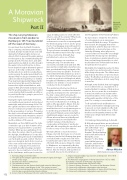
Neuwerk beacon in a storm, 1840
152
Gnadau13. Brother Hastings and his wife will reside at Kleinwelke, (near Bautzen14), after thirty years faithful services in Labrador, and Brother Kunath will return to his station in that country.
With thanks to Lorraine Parsons
Adrian Wilsdon
1.  A fishing village on the River Elbe.
2.  The rights of the salvagers apparently overrode the rights of the legal
owners of any cargo.
3.  Possibly some kind of cooked food.
4.  The controller of wrecks.
5.  The Mennonite van der Smissen family had moved to Altona from
Brabant in what is now Belgium in the 17th century to avoid persecution and subsequently became successful businessmen. There is to this day a van-der-Smissen Street in Altona.
7.  Johann Christian Seyffart was minister at Altona from 1814-1818 and then 1823-1834.
8.  The Moravian congregation in Altona lasted from 1763 to 1885. 9.  Probably a member of the Altona congregation.
10. A town near Altona under the Danish crown.
11. A town in Saxony, Germany. The centre of the Moravian Church. 12. A town with a Moravian congregation near Herrnhut.
13. A town with a Moravian congregation in Saxon-Anhalt, Germany. 14. A town with a Moravian congregation near Herrnhut.
6.  A town close to Hamburg at this time under the Danish crown.


