


Page 6 - Moravian Messenger January 2019
P. 6
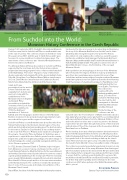
Teltschik's family home © Sr Sarah Groves
Dr Horst Schinzel, Daniel Rícan, Lubomír Kuc Museum of the
and Daniel Dvorsky, conference organisers © Sr Sarah Groves Moravian Brethren © Sr Sarah Groves
From Suchdol into the World:
Moravian History Conference in the Czech Republic
During 21-23 September 2018, the Eighth International Moravian Conference was held in Suchdol nad Odrou: a small market town in the east of Czechia. This conference has been held there every three years since 2001, and this year Sr Sarah Groves and I were honoured to receive invitations to attend and give papers. The main theme of the conference was 'How the Moravian Brethren Enriched Countries and Nations'.
The Moravian National History Association in Suchdol nad Odrou, supported by the local town and other historical associations, prepared an interesting program for the conference which was held in the Klub Kultury. There were 19 papers, many of which were about people who had emigrated from the area including Johann Teltschik, Georg Kunz, Josef Kuyera, Wenzel Weber (missionary in St Croix), Daniel Neisser (missionary in the Caribbean), Rosina Nitschmann, Marie Katerina Jelínková and the Neisser clan.
Sarah and I gave
presentations on the work of
Johann Teltschik, who was
originally from Suchdol, and
went on to help with the
establishment of the
Moravian Church in England
and Ireland. Other
presentations included the
centenary of the Czech State
which was established in
1918, the Brethren's'
translations of Texts into
Kalmyk and other languages, and the mission of the Moravian Brethren in Livonia. It also provided a great opportunity to learn more about the region and the origins of our Church.
Suchdol nad Odrou is a small market town, about five miles from Fulnek, that belongs to the Moravian Silesian region of Czechia, which was historically a German speaking area. The German name for the town is Zauchtel or Zauchtenthal. It has a railway station on the route from Prerov to Ostrava and is situated in a triangle of three towns - Novy Jicín, Odry, and Fulnek. In 1624 there was a royal decree to expel all the non-Catholic priests from the country. Despite this, unlike the neighbouring villages, the whole village of Suchdol managed to remain essentially evangelical until the issue of the Tolerance patent in 1781.
In 1722, Kristian (Christian) David of Zenklava, helped refugees from Moravia to escape to Saxony, and stayed on the estate of Count Zinzendorf where he felled the first tree for the new settlement at Herrnhut. David also visited Suchdol, where his sermons created a great spiritual awakening in the local people. Over the next sixty years, around 280 inhabitants emigrated from Suchdol to Herrnhut. More than 60 of these people went on to become mission workers in the Moravian Church. The conference revealed the work and lives of some of those people and included an exhibition of the Moravian Church's work.
Daniel Rícan, President of the Moravian National History Association,
has devoted his time and energy to documenting and displaying the story of the Moravian Brethren from Suchdol, and to share what they did to bring the Gospel to the world. The History Association not only organises the conference every three years but has also established and manages the Moravian Brethren's Museum (Muzeum Moravskych bratrí) and the Moravian Brethren's Park (Park Moravskych bratrí). This park is located on the site of David Nitschmann's house - the first bishop of the renewed Moravian Church.
At the park there are many plaques in honour of the Moravians who left Suchdol for religious freedom in Saxony and whilst we were there two new plaques were unveiled in honour of two Suchdolians and two memorial trees from places where Moravians worked were planted: one from Dublin and another from Herrnhut. I had the pleasure of unveiling the plaque for Paul Munster and
Sarah planted the tree from Dublin. The History Association also organised the Via Exulantis a walking trail of about 215 miles from Suchdol to Herrnhut along the sites that the first emmigrants to Herrnhut with David Nitschmann Syndikus followed.
On the first day of the
conference we also ventured out to the 'Forest Church' of Martin Schneider (about a mile away) where a simple service was held. The second day started
with a wonderful performance from the Skrivánek Children's Choir, and in the afternoon there was a coach excursion to the Kravare region where we were taken through many areas of historical and political interest. One of the stops was at the house where Kristian David was born in Zenklava.
On the last day, there was a final presentation about the mission work of the Moravian Brethren from the area. Worship was then held in the Evangelical Church of Czech Brethren, which was followed by a guided tour of the church including a climb up the church tower. After lunch we were given a tour of Suchdol and finally discovered Johann Teltschik's house, now sadly in a state of disrepair.
The conference provided a wonderful opportunity to learn not only about the area but also of the many Moravians from that region who fled and later worked in the mission field. We were well looked after, staying in the local guest house and great efforts were made to ensure that the conference was translated for everyone. We would like to thank Daniel Rícan and Daniel Dvorsky in particular, for all their help and hospitality and look forward to the next conference in 2021 when perhaps other British Moravians will be able to join us!
Sr Lorraine Parsons
Editorial Team and Provincial Archivist
Out in the 'Forest Church' © Moravian National History Association
150


