


Page 6 - Moravian Messenger April 2021
P. 6
Labrador - off to the unknown
Settling in
We soon got into a routine at school. As television had not yet arrived in the coastal communities and the expensive radio we had brought with us from England only picked up the BBC World Service sporadically, our lives revolved around school from early in the morning to quite late at night. The school staff became our family, and we were an eclectic bunch from England, the USA and Canada. Many evenings and weekends were also spent with shared meals and playing Monopoly or Scrabble.
As winter approached, the daylight hours grew shorter and shorter and, although we were not in 'the land of the midnight sun' with six months of daylight and six months of darkness, on the shortest day of the year the sun came over the horizon at about 9am or so and had disappeared by 2pm. The temperature also began to drop dramatically and soon fell to zero, whilst the snow showers became a regular occurrence.
Getting kitted out: We were soon in need of proper winter coats and were advised to go and see Hulda Lidd, one of the local seamstresses, which we duly did. We stood in her small room and asked whether she needed to measure us. She just grinned, shook, her head and said, 'Come back in a week for a fitting'.
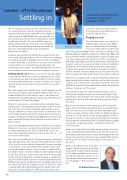
Our coats comprised of a duffel 'inner' coat for warmth (a cloth imported, as it happened, from West Yorkshire) with a hood trimmed with arctic fox fur and an 'outer' coat made from Grenfell Cloth (not unlike gabardine) which was both waterproof and windproof. This was the silapak.
Wendy's coats were decorated with embroidery whilst mine, being a man's coat, was plain except for three rings of braid on the cuffs. The colour of the braid was significant because it indicated whether you were single, married or widowed - and in the depth of winter, with the hood pulled across the face it helped to identify your marital status! Within the week the coats were completed, fitted perfectly, without even the need of a tape measure!
It soon became apparent that we also needed proper footwear. Walking to school one morning I felt something in my leather boot give way. On arrival, I discovered that the soles of my shoes had completely cracked across due to the cold. So ... off to the boot makers next.
We ordered our sealskin boots. The uppers were decorated seal skin, although many of the men wore boots with the fur scraped off to stop the snow sticking to them while they were hunting or working. The soles were made from scraped seal skin and were thicker than the uppers. The soles were so thick that the bootmakers had to chew the sealskin to make it pliable enough to sew. Very often you could see the older women whose teeth had been worn down by the continual chewing of sealskin. The upper was finished with a sleeve of cloth through which braid had been threaded to enable the boot to be drawn tight around the calf to keep the heat in and the snow out. The boots came complete with calf length duffel inners for warmth. We each got a pair of duffel slippers too. Whenever you went to visit
someone's home you removed your boots and sat in your duffel inners or took your slippers along.
Keeping in touch:
The mail plane came once a week on a Wednesday, and passenger flights were on a Wednesday and Saturday - if you were lucky and the weather was
clear! The Labrador Airway's fleet consisted of a number of De Haviland Beavers and Otters built in the 1950s and 1960s and were our lifeline with the outside world once the sea had frozen over. These planes were the workhorses of the coast and all flew VFR (visual flight rules) which meant they could only fly if the pilot could see the ground and had one mile of visibility in the daytime. As the winter drew in there were many delays because of the weather and it wasn't unusual to be without mail for a month. There was always a buzz of excitement in the classroom when we all heard the drone of the plane overhead.
There were no runways in the coastal communities at that time, which meant that the planes landed on skis on the frozen bay in winter and on floats in the open water in summer. The most difficult times were the Spring and Autumn during the transition between 'break up' and 'freeze up'.
Such was the isolation for many that when a plane arrived, many people would go down to see how many bags of mail had arrived on the mail plane, who had arrived on the passenger plane and to catch up with any news and gossip from along the coast!
Once the mail had been sorted at the post office we would queue after school with eager anticipation to see what news had come from home. It could be an emotional time as we could receive the sad news of the death of a family member in one letter or good news of a forthcoming wedding or birth in the next. It could be a rollercoaster, but a vital part of keeping in touch with the outside world. Both our mothers wrote regularly every week so it was important to read letters from home chronologically.
It was ironic that at the time while we were safely ensconced in our centrally heated apartment, back in the UK our parents were telling us about the miners' strikes and lengthy power cuts. Instead of receiving food parcels as we regularly did from home we felt as if we should be sending support in the opposite direction!
By the end of October, the snow had begun to fall and stay, the ground was frozen and the water in Nain bay began to look darker and darker and soon froze over. We were about to experience our first Labrador winter with temperatures soon dropping to -10°C and lower ... tbc.
Br Robert Hopcroft
Wendy in her Duffel
Continuation of Br Hopcroft's memories of his call to Labrador in 1971
42
© Br Robert Hopcroft


