


Page 9 - Moravian Messenger October 2019
P. 9
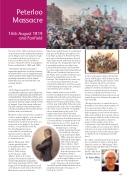
Peterloo Massacre
16th August 1819 and Fairfield
The turn of the 19th Century was a time of great unrest in the newly industrialising areas. Wages were low and prices high. Corn Laws had driven up the price of basic foods which were beyond the means of many. From the Congregation Diaries at Fairfield of 1808 and 1809:
'The present slackness of trade is especially oppressive to cotton weavers of whom there is, in our neighbourhood, a great number; their wages having been gradually lowered to such a degree especially, such as have families, can scarcely subsist.'
and
'At the beginning of this month considerable collections were made here and in our neighbourhood and likewise in Dukinfield for the benefit of those who partly out of want of work, and partly on account of very low wages, stand in need of support. From the money collected, the poor sufferers were provided with victuals according to the number of their families and circumstances.'
Workers became interested in a political solution and the right to vote and were encouraged by Radical Reformers. However the people in power were not interested in the plight of the textile workers, or in political reform. At
this time Magistrates were responsible for maintaining law and order locally and often involved the military to maintain peace.
On the 9th August 1819
a mass gathering had
been planned in the centre
of Manchester, at St
Peter's Field, a large
enclosed space, with
'Orator' Hunt as the main
speaker. This however had been declared illegal by the magistrates
and it was rearranged for the 16th August 1819. Working people from all over what we now know as the Greater Manchester area marched into
Manchester with banners. It is estimated that about 80,000 people gathered to hear Hunt speak at St Peters Field. This was a peaceful demonstration. Around 1pm, Hunt arrived and made his way to the hustings. The magistrates who had been watching from a nearby house believed Hunt should be arrested with the other ringleaders. Before Hunt arrived 200 special constables had gone onto the field to form a corridor from the house where the magistrates were to the hustings. The magistrates became very concerned and read the Riot Act also ordering the military to arrest the people on the hustings as the Special Constables reported they were unable to.
Many regular army troops and the Cheshire and Manchester Yeomanry were already stationed in the surrounding area and were sent for. The Cheshire and Manchester Yeomanry were first to arrive, on their way striking Mrs Fildes who was carrying her two year old son and killing him. They entered St Peter's Field with sabres drawn lashing at people. The regular army then arrived and was ordered onto the field. As the protesters tried to escape they found their avenues of escape wholly or partially blocked off. This resulted in more of the dead and,
certainly the wounded, being trampled upon or being
crushed against the barriers. It is believed 19 people
died and between 600- 700 people were injured although the true figure
will never be known. Henry 'Orator' Hunt was sentenced to two years imprisonment
and other people on the hustings, Samuel
Bamford, Joseph Johnson and Joseph Healey received
a year and John Knight two years. They were all charged with
'assembling with unlawful banners at an unlawful meeting for the purpose of inciting discontent'.
In the Congregation Diary, at Fairfield, dated 16th August 1819 written by Rev Carl August Pohlman, the minister of the time, he writes about the protesters returning home. There was concern within the Settlement that there may have been reprisals from the returning protesters towards the Brothers and Sisters at Fairfield as they had not joined in with the protest. However they passed by peacefully:
'We were therefore so much the more thankful to God, when great numbers of these people passed by our place, on their return from the scene of action, without giving us the least molestation, altho much irritated. It is our most earnest wish & prayer, that all our Brs & Srs may, in these distressing times, when the wages of the working class of the community, in this manufacturing part of the County, are so very low as to afford such persons a very scanty maintenance, unite in prayer to the Lord to give us grace to abstain from everything in word & deed'.
A booklet containing much more about the circumstances before, during and after the events on 16th August 1819 entitled 'Tameside Remembers Peterloo' is available for
£4.00 + P&P from jwarr@uwclub.net.
Sr Janet Warr
Fairfield
117


