


Page 5 - Moravian Messenger September 2019
P. 5
Friends of the Archive Garden Party
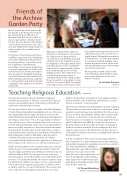
On the hottest day of the year to date the Friends of the Archive hosted their first Garden Party on 28th June at Moravian Church House in London. It was an opportunity to thank everyone for their generous support of the Archive over the years and to view some of the work and exhibits at the archive and meet a few members of our newly formed committee.
The Friends of the Archive was formed in 2008 to support the work of the library and archive at Moravian Church House by raising funds for: conservation work, the acquisition of new material, transcription of documents, and purchase of specialist equipment etc. It also seeks external sources of funding and helps to raise the profile of the library and archive. Since then it has raised thousands for the Archive and last year formed a committee to continue with its work and to formulate a strategy for the support of the Archive and Library.
Although a 'Garden Party' had been arranged, on arrival we soon moved into the chapel to move away from the excessive heat outside! After lunch and refreshments in the chapel, the work on the digitisation of the glass lantern slides from the Labrador mission field which dates from the early twentieth century was shown through a more modern digital projection. These slides were once used by the missionaries when on furlough back in the UK in 'Magic Lantern Shows' around the congregations to raise funds for their mission work. The quality and clarity of many of the lantern slides
has survived extremely well and has not suffered any loss in the conversion to a digital format. Afterwards we moved up to the library to cool down and examine the variety of material available in the archive and discuss how it can be used -
this was followed by a tour of the archives stored in the basement.
We would like to thank everyone who visited that day and would like to plan more events with the Friends of the Archive next year.
Sr Lorraine Parsons
Archivist
have the opportunity to discover Judaism, including its foundations and practices. This also covers the Holocaust, an emotive, yet important aspect of the history of the faith for students to understand and consider.
The last year of Junior School is a study of the World Religions of Islam, Hinduism, Buddhism and Sikhism and one of the most important things that we study. Teaching in a school in the heart of Belfast, we have pupils from a wide range of backgrounds and religious experiences. This is the opportunity to embrace each and every one of these and help others to become more tolerant and understanding. In the school year just finished, it was an incredible experience to hear from parents and pupils how important they felt it was to learn about these religions and how they better understood exactly why their friends were fasting during the month of Ramadan or why they left to complete their Salah prayers at lunchtime. It is having conversations like these that show the significance of embracing these religions in the classroom, in a safe and inclusive space.
GCSE Level brings with it some of my favourite topics to teach, and we begin to move away slightly from what is studied in church backgrounds. Philosophy of Religion is the first topic my students study at GCSE. Here we get to discuss some very interesting issues, such as the problem of evil and suffering, the existence of God and the afterlife. Not only do students study the Christian and Islamic perceptions on these issues but also look at atheistic and agnostic perspectives, as well as a more in-depth look at the concept of Humanism. These lessons are some of the more challenging to teach as there are many
debates and questions arising that it is not always possible to have an answer to, this is where the useful phrase, 'research that for homework', comes into play!
The final year of GCSE is the Christian Ethics module exploring Christian views on issues such as abortion, euthanasia, capital punishment and marriage. As you might tell, from these topics, there is excellent opportunity for debate and discussion and I am able to conduct some of my favourite lessons that give much more voice to students in considering arguments in line with the different issues. With the continuous discussion in Northern Ireland on abortion laws and same sex marriage it shows the students how what they are studying in R.E. does apply to wider aspects of life. Our students, if they choose to, can further their study of ethical issues and Biblical modules at AS and A2 Level.
It is fair to say that no R.E. teacher would disagree with me when I say that it is a subject that presents many challenges, particularly in keeping the engagement on just how relevant it is to them but when this challenge is
fully embraced to give students the best experience they can receive of the subject we can create students who are more knowledgeable, understanding and prepared for the different people and situations they will meet when they leave the R.E. classroom.
Sr Tanya Macartney
Teacher, University Road
Teaching Religious Education
continued
101


