


Page 7 - Moravian Messenger March 2019
P. 7
Part
1
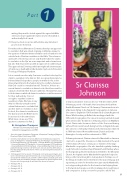
Sr Clarissa Johnson
writing, they must be tested against the agreed infallible criteria, to insure against deception and to show what is authentically God's word.
(3) Everyone must accept as authoritative any statement proven to be from God.
From these three affirmations Comenius develops an approach to revelation that was aimed at giving a definitive answer to the question of whether divine revelation can be found in books outside Judeo-Christian revelation in the Bible. The relevance and worth of Comenius are not only that he takes the claims to revelation in the Qur'an as an important and relevant issue but also that he provides us with an approach to addressing it. This approach by Comenius, which we might call a hermeneutic of harmony, is dealt with in fuller detail in my book, A Protestant Theology of Religious Pluralism.
Let us remind ourselves why Comenius could not side-step this claim to revelation in the Qur'an: first, as a ground principle, he believed that God speaks to people: in written books, in the physical world and in the human mind. Secondly he believed that God couldn't contradict himself. Therefore, if there are several claims to revelation in divine books, then there must be a way to decide whether they are authentic. His task, then, was to find a basis on which all claims to revelation could be assessed for their authenticity. It is not
enough to say that a claim to revelation is false. We have to say why it is false by using the same criteria that we use to conclude that another claim to revelation is true. In short, the claims to revelation in the Qur'an and in the Bible have to be assessed on the same basis. What basis can we use? This question is answered in Part 2.
Sr Clarissa (Clarister) Johnson died on 15th December 2018 following a period of ill health. Her funeral was held at New Beulah Moravian Church on 5th January. Clarissa was born into a Moravian family in the Nazareth Congregation in Jamaica. She came to England in 1969 and trained as a State Registered Nurse. Whilst working in Belfast she worshipped with the Cliftonville Congregation. Her career in nursing reached its peak when she became the Director of Nursing Services in Waltham Forest. Clarissa also became a Justice of the Peace and having suffered from racism herself during her time in England she was also active in community relations work. Clarissa was ordained in 1989 and served Hornsey Moravian Church and Stoke Newington Society until her retirement in 1998.
Following retirement, Clarissa returned to Mandeville in Jamaica - but not to a quiet life. She was soon fully involved in the work of the Jamaica Province, serving as co-minister of the large Mandeville congregation. She also travelled regularly climbing rough hill roads to lead worship at Nazareth and Huntley, where she had grown up. But her work was not limited to the Moravian Church. As chaplain at the Mandeville Hospital she helped to bring comfort and strength to many patients. Perhaps one of the things she will be best remembered for was setting up and supervising a centre for homeless men just outside Mandeville, not only providing shelter for the homeless but helping them to find work and a purpose in life. As always she brought vision and compassion, a deep concern for people to all she did.
31
i
Br Livingstone Thompson
Minister of University Road and Kilwarlin Congregations, and PEC
See in this regard, Livingstone Thompson, A Protestant Theology of Religious Pluralism (Oxford: Peter Lang, 2009).
ii   Comenius Consultaiton on human Affairs has the following component parts: (I) Panegersia - Universal Awakening; (II) Panaugia - Universal Light (or Universal Dawning); (III) Pansophia - Universal Wisdom; (IV) Pampaedia - Universal Education; (V) Panglottia - Universal Language; (VI) Panorthosia - Universal Reform (VII) Pannuthesia - Universal Warning. Parts I & II were published during Comenius' life-time but it was not until the 20th century that the remainder became known. There is as yet no English translation of parts III & VII.
iii   In Panaugia III, 24 he asserts: “Christianity is the only sound religion, and since it has been built upon the firmest rock, no true reasoning nor evidence of truly divine revelation can unsettle it. Other religions are built upon sand with the straw and stubble of human interventions or devilish illusions, and they are not strong enough to withstand the torrent of reasons.”
iv   Panaugia, VII, 2. v   Panaugia, VII, 8. vi   Panaugia, VII, 8. vii  Panaugia, VII, 9.


