


A journey to the Moravian Churches in India, 17th-23rd April 2026 – Part 2
Continuation of the article from last month’s issue …
On Friday, 17th April, we travelled to Latingkhal in Manipur. We spent about two hours travelling together with Br Jacob and Br Nathaniel’s family on the Barak River. Due to the rainfall, the water was brown in colour. Br Levi’s father was already waiting for us in the boat that picked us up in Binnakandi and welcomed us. We experienced this appreciation for our visit time and again, and it shamed me deeply. Passing bamboo rafts and fishing boats, we entered the Jiri River, a tributary of the Barak River, which marks the border between the states of Assam and Manipur. In Latingkhal, a devastating storm with hail had struck on 15th March 2026, causing severe damage to many roofs. With the onset of the rainy season, swift action was required. Many people were forced to borrow money to repair their roofs. Thankfully, after consulting with the Board of Elders in Ockbrook, Br Joachim was able to pass on a donation of £500, which had been given by a group of Americans during a visit. We met the parents of Br Dimchui, who is currently serving for 11 months in the South West Province of Tanzania with his wife Dimjeng. The village is not large. People live off their livestock, the vegetables grown in their gardens and, of course, the rice cultivated in the surrounding fields.
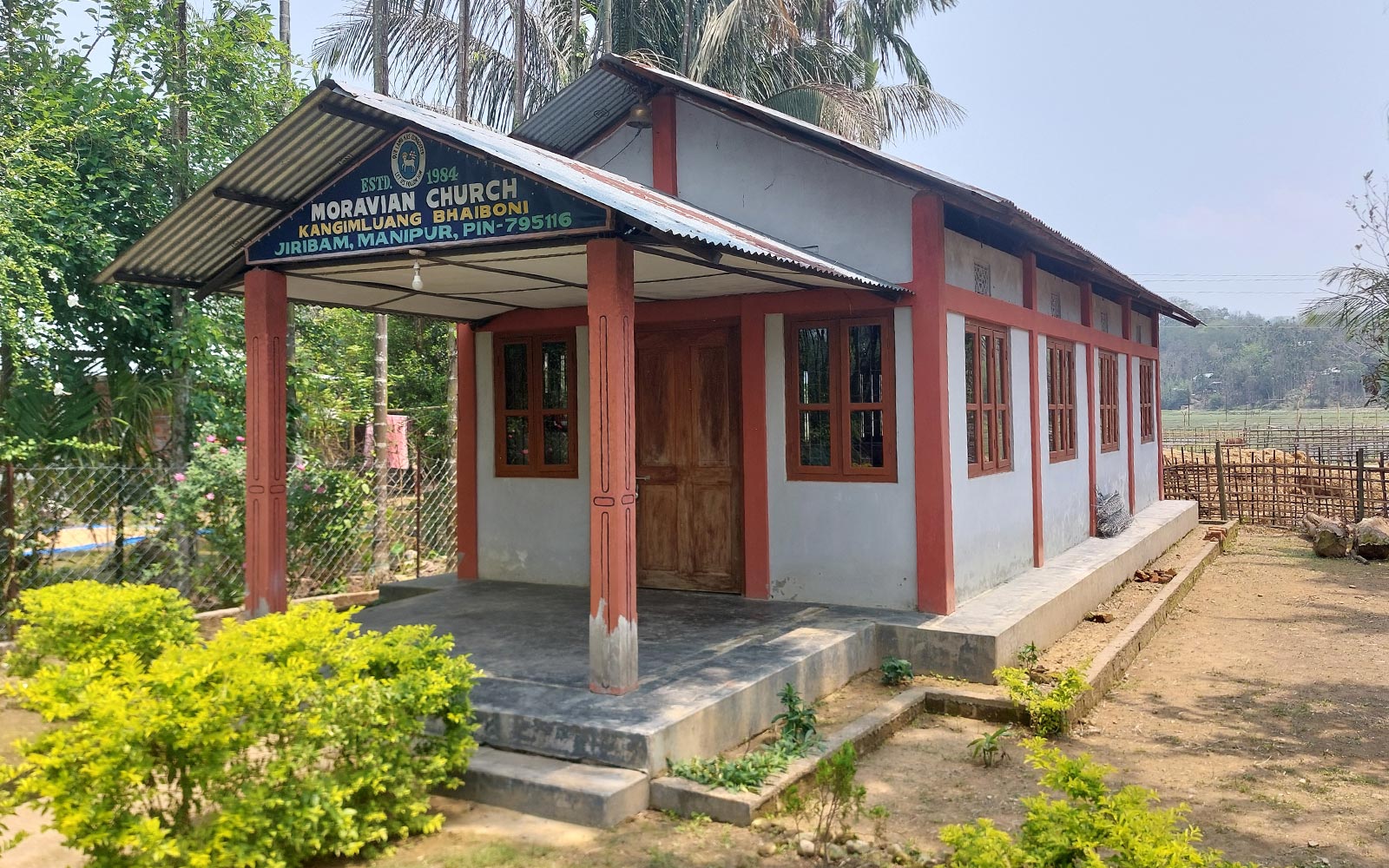
Church in Latingkhal
The return journey was considerably quicker, as we were able to travel with the current. A wonderful dinner awaited us, consisting of rice, dal, yeast dumplings stuffed with chicken, beans, carrots, bananas, melons and apples. During the night there was a heavy thunderstorm and tropical rain pounded down on the tin roof.
We set off early on Saturday 19th April, to visit the Rubber Farm near Binnakandi. It was established as a church-run enterprise and initially generated a good profit, which was used to fund the construction of the church. Unfortunately, the price of natural rubber on the world market has fallen so much that the farm now yields very little profit. The area where the rubber trees stand in the dense forest is considerably larger than the farm itself. It is situated on a mountain and belongs to the church. Here, too, we heard ideas about what might be developed there. Perhaps a graveyard for the Moravian Church?
Sunday 19th April was entirely devoted to the church services in Binnakandi and Silchar. The service began at 8am, and for good reason. It is not yet as humid as it gets later in the day. The fans were running at full speed, and the generator in the shed ensured a stable power supply, including for the microphone and electric guitar. Once again, the service began with about half an hour of singing. Many of the songs in the Rongmei language come from what was originally a Baptist hymn book. They also use a hymn book that they have published themselves. Despite the book and the projector, the next line of each song was read out loud so that everyone could really sing along.
After the service, we sat together for a while. We had lunch, and as always, there was some good tea. I often had the impression that, despite the ever-present mobile phones, time sometimes stood still and we simply savoured the moment.
In the afternoon, the congregation in Silchar was waiting for our visit. At the last synod, it was officially recognised as a church. Silchar is the capital of Cachar District and, with a population of around 180,000, the second-largest city in Assam. Many people speak Bengali. The members of the Moravian Church met in a flat; there were about 30 of them. We sang, exchanged greetings and celebrated Holy Communion together. The children were always present and sang for us some songs they had learnt in the Sunday school. A shared meal, a prayer for the children and a group photo brought the memorable gathering to a close.
In the evening, we met once again with the elders and the congregation in Binnakandi. Fish was fried in a large pan over an open fire. There was rice, vegetables and fruit, and words of gratitude were exchanged. As we were leaving, we accompanied a brother home to his wife, who has been paralysed for 15 years.
On Monday morning, 20th April, it was hard to say goodbye. Despite the early hour, members of the congregation were there again to bid us farewell. Br Titus and Br Nathaniel drove us to the airport in Silchar. And they did so even though it was Br Titus’s first day back at school. We had already said goodbye to Br Jacob beforehand. I find it hard to find the words to describe how lovingly and thoughtfully those in charge looked after us and how well they tried to explain to us the society and culture in which they live.
We flew back to Delhi, where I said goodbye to Br Joachim. Whilst he was preparing for the Synod of the Moravian Church in South Asia in Kathmandu, I travelled on to visit Susan and Thsespal Kundan in Dehradun/Rajpur. I was a guest there for two days, got to know the Moravian Institute, visited the church and took part in a prayer meeting of the congregation in a flat. There I also met Br Bir, who had been part of the ‘Study Group’ mentioned at the beginning. Once again, the welcome was very warm and it felt a bit like home to me. At the school, I also met staff and students from Assam, and it became very clear to me just how significant a role the Moravian Institute plays in the development of the congregations in Assam and Manipur.
The Daily Watchwords accompanied us every day. For me, as a former editor of the Watchwords, this was always a special moment. We read the words in Rongmei, Hindi, English and German. It inspired us in our prayers and devotions. We heard from people living in difficult circumstances who felt strengthened by the Daily Watchwords. As I set off for Delhi airport on 23rd April, the Watchword read: ‘For this reason I bow my knees before the Father, from whom every family in heaven and on earth takes its name.’ (Ephesians 3:14-15). Filled with great gratitude towards this Father in heaven for the many precious encounters and for His protection along the various journeys, I flew home. And now I carry these experiences with me, hoping to spark interest in our congregations and among my circle of friends. Naturally, one considers how and where one can support the brothers and sisters. But the most important thing, which we have assured one another of in every congregation, is mutual prayer to our common Father in heaven.
Br Erdmann Becker
Retired Pastor, Kelheim, Bavaria
More Spotlight News

Introducing a new member to the Provincial Board

Reflections on Synod 2026
